Overarching philosophy: scaffolding, not handholding nor hands-off
Training in the Dada Lab is designed to foster critical thinking, ownership of work, sound scientific judgment, and increasing independence. These are central goals of scientific training.
Independence does not mean working alone, avoiding questions, or withholding concerns. It means learning to prepare, think critically, make informed decisions, seek input thoughtfully, and take responsibility for one’s work. Through scaffolding I provide trainees with clear research expectations, appropriate structure, resources, feedback, and opportunities for practice so that they can progressively take ownership of their work. This approach sits between the two extremes of handholding and hands-off. It provides the level of guidance needed at a given stage of development while deliberately building the skills, judgment, and confidence required to foster independence. The level and type of support will evolve as each person gains experience and demonstrates competence. Early in training, this may involve foundational instruction, close guidance, modeling, supervised practice, and frequent feedback. Over time, lab members are expected to take increasing initiative in planning, communicating, troubleshooting, documenting their work, interpreting results, and contributing to the collective success of the lab.
My role
My role is to set the scientific direction of the lab, help lab members develop the scientific, technical, and professional skills needed to develop into independent scientists. This includes providing guidance and feedback, helping to identify barriers and think through challenges, supporting lab members as they build confidence and take increasing ownership of their work, and ensuring that work remains aligned with the lab’s scientific, training, and programmatic goals.
My approach
My approach is to provide a strong and transparent framework that supports each lab member in meeting the goals of their training period (or time in the lab) and developing toward greater independence. This framework is designed to provide the conditions, clarity, and support needed to make meaningful progress toward training, research, and professional-development goals.
The lab’s training and development structures include:
- a clear training plan with long-, mid-, and short-term goals
- foundational onboarding and technical training
- a competency-development and tracking system
- an Individual Development Plan
- a mentoring agreement that clarifies shared expectations
- regular opportunities for feedback, troubleshooting, reflection, and course correction.
I work with each member as well as collectively as a team where necessary to addapt these structures adequately.These systems are not intended to create unnecessary administrative work or to monitor people for its own sake. They exist to make expectations visible, help trainees recognize and document their own development, identify barriers before they become more consequential, and ensure that training remains purposeful rather than reactive. Trainees are expected to actively participate in this process. This includes preparing for meetings, communicating progress and barriers early, following through on agreed next steps, maintaining complete records, and seeking input after first engaging thoughtfully with the problem at hand.
A central component of this approach is the lab’s weekly meeting. It provides a regular structure for coordination, accountability, scientific discussion, professional development, and collective problem-solving. Through repeated participation in this process, lab members learn not only how to conduct research, but also how to reason through uncertainty, communicate clearly, contribute constructively to a team, and lead increasingly independent scientific work.
Responsibilities of trainees
Trainees are active participants in their own development. Each is expected to:
- complete requisite foundational trainings that are provided during the onboarding process and throughout the training period
- actively and consistently use and apply the career development tools and structures that we establish together
- read and synthesize relevant literature
- prepare thoughtfully for meetings and discussions
- take ownership of their projects and responsibilities
- manage time and communicate priorities, barriers, and changing circumstances early
- maintain complete and usable records of their work
- ask questions and seek input after engaging seriously with the problem
- use feedback to improve their work and professional practice
- contribute to a productive, respectful environment for others
Learning by doing: actually show up and get things done
“Just learn how to get stuff done.”
—Barack Obama
I believe that scientific training requires direct engagement with the material realities of research. While reading, planning, and discussion are essential, they do not replace the learning that comes from working with organisms, materials, instruments, data, and experiments themselves.
Much of scientific judgment develops through hands-on experience i.e. learning the feel and limits of a technique, recognizing meaningful variation, noticing when something is not working as expected, responding to practical constraints, and understanding how individual tasks connect to a larger project. These forms of judgment cannot be developed through thinking, observation or discussion alone.
Accordingly, lab members are expected to participate regularly in the shared research environment in ways appropriate to their role and stage of training. While some aspects of research like reading, writing, coding, planning, and analysis may at times be completed independently or outside the lab space, these activities complement rather than replace in-person engagement. Experimental science is learned through direct involvement, including handling materials, practicing techniques, contributing to shared work, troubleshooting, and following projects through.
This approach is consistent with research on embodied and sensorimotor learning, which suggests that physical engagement with scientific phenomena can deepen conceptual understanding and support later reasoning about them (PMID: 25911125).
Growth through process, practice, and iteration
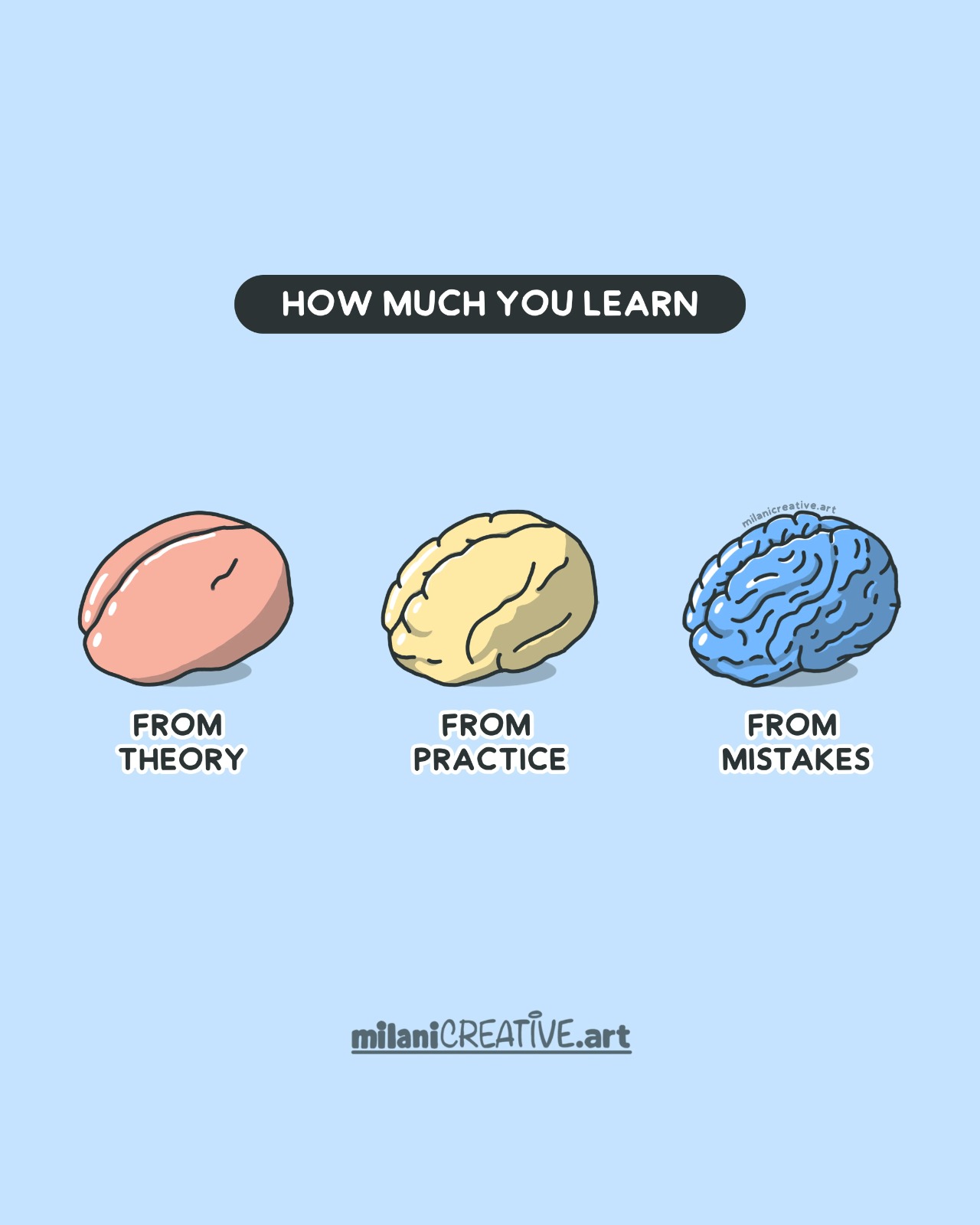
Scientific progress is not linear. Experiments fail, methods require revision, data can be ambiguous, and promising ideas may not hold up. These experiences are not evidence that someone does not belong in science. They are part of how scientists develop. The lab uses the idea of failing upward to describe a disciplined response to setbacks:
- identify what happened
- distinguish what is within your control from what is not
- document the problem, seek appropriate input, revise the plan, and move forward with stronger understanding Progress should not be measured only by outcomes such as a positive result, accepted paper, funded proposal, or completed experiment. We also value the quality of planning, rigor of execution, willingness to revise an interpretation, clarity of communication, persistence through difficulty, growth in judgment, and contribution to others’ work. Repeated cycles of planning, conducting experiments, interpreting and presenting results, writing, and revising are how projects mature and how scientists become capable of leading increasingly complex work.
Scientific training as an interaction
I view scientific training as an interaction among the trainee, the principal investigator, and the research environment. Scientific growth does not occur through the efforts of a trainee or mentor alone; it develops through the quality of these interactions over time.
Each part of that interaction matters. Trainees must engage actively in their own development. I provide direction, coaching, feedback, and opportunities for growth. My goal is to foster a research environment that is safe, organized, inclusive, intellectually engaging, and structured to support careful work and learning from one another.
My aim is not simply to help trainees complete experiments or generate results, but to help develop scientists who can think critically, take ownership of their work, communicate clearly, respond constructively to uncertainty and setbacks, and contribute meaningfully to a scientific community.
Feedback: direct, specific, and grounded in care
Feedback is an essential part of scientific training. My communication style is direct and analytical, and I aim for feedback to be specific, transparent, and grounded in the reasoning, evidence, and expectations relevant to the work. I aim to provide feedback that is direct enough to be useful while also supporting growth.
Comments may be candid, particularly when a scientific, organizational, communication, or professional practice needs to improve. Feedback is directed toward the work; including reasoning, experimental design, documentation, interpretation, communication, planning, and follow-through; rather than toward a person’s character or worth.
Lab members are expected to receive feedback thoughtfully, ask clarifying questions when needed, and make a good-faith effort to incorporate agreed revisions. Lab members are likewise expected to provide peers with feedback that is specific, constructive, and grounded in evidence or clear reasoning.